Contributor
The Priangan Post contributor
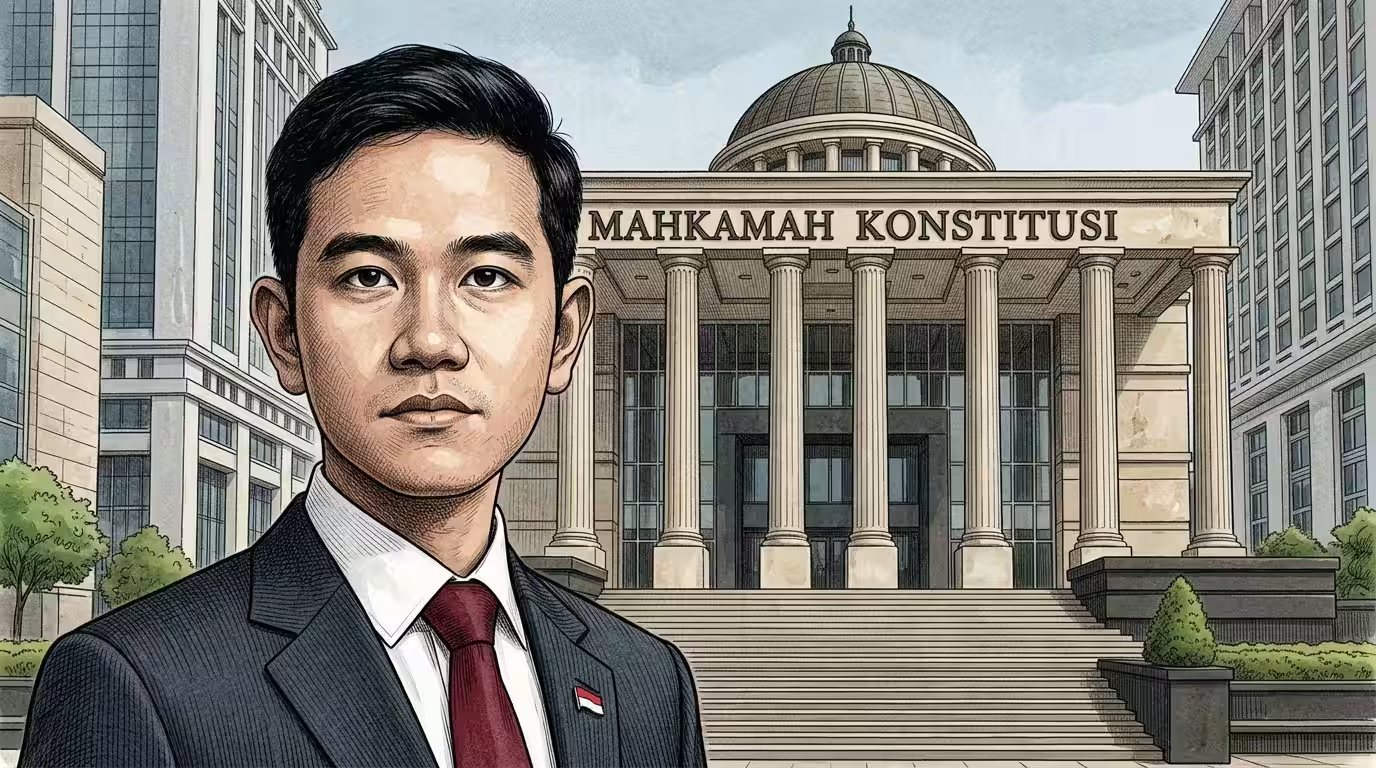
Nearly two years after Gibran Rakabuming Raka was sworn in as Indonesia’s vice president, the Constitutional Court is hearing a new challenge to whether he legally satisfied the educational requirements to run in the 2024 presidential election.
The case, registered as 01/PHPU.PRES-XXIV/2026, was filed on September 10 and formally registered by the Constitutional Court on September 17, 2026. The first hearing took place on September 21.
The petition goes substantially further than asking the Court to review an administrative document.
The petitioners are asking the Court to:
- declare that Gibran failed to meet the minimum educational qualification for vice-presidential candidates;
- disqualify his 2024 candidacy;
- invalidate the KPU decision insofar as it approved Gibran as a vice-presidential candidate;
- annul his inauguration as vice president; and
- order the People’s Consultative Assembly, or MPR, to elect a new vice president from two candidates nominated by President Prabowo Subianto within 60 days.
No such ruling has been issued.
Gibran remains Indonesia’s vice president, and the petitioners’ allegations concerning his educational eligibility have not been established by the Constitutional Court.
The case in brief
The dispute centers on a seemingly simple statutory requirement.
Article 169(r) of Indonesia’s 2017 Election Law requires a presidential or vice-presidential candidate to have completed at least:
senior high school, madrasah aliyah, vocational senior high school, vocational madrasah aliyah, or another equivalent school.
The same substantive requirement was repeated in Article 13(1)(r) of KPU Regulation No. 19 of 2023, which governed the nomination of presidential and vice-presidential candidates for the 2024 election.
The controversy is not simply about whether Gibran attended educational institutions.
Instead, the case asks whether the documents used during his candidacy legally demonstrated that he had completed education equivalent to Indonesian senior high school, as required by the Election Law.
What Gibran’s official KPU profile says
The KPU’s 2024 election portal listed Gibran’s educational history as follows:
| Level | Institution | Period |
|---|---|---|
| Primary school | SD Negeri Mangkubumen Kidul 16 | 1993–1999 |
| Junior high school | SMP Negeri 1 Surakarta | 1999–2002 |
| Senior high school | Orchid Park Secondary School, Singapore | 2002–2004 |
| Senior high school | UTS Insearch, Sydney | 2004–2007 |
| Undergraduate | MDIS Singapore | 2007–2010 |
The KPU portal also listed his highest educational level as S1, or undergraduate degree.
The KPU formally approved Prabowo Subianto and Gibran as candidates through KPU Decision No. 1632 of 2023, issued on November 13, 2023.
They subsequently won the election. KPU Decision No. 504 of 2024 recorded 96,214,691 votes, or 58.59% of valid national votes, for the Prabowo-Gibran ticket.
Prabowo and Gibran were inaugurated as president and vice president on October 20, 2024, for the 2024–2029 term.
None of those facts, however, resolves the present dispute over what documents were legally sufficient to establish Gibran’s minimum educational qualification.
The crucial KPU regulation
One of the most important provisions in the case is Article 18 of KPU Regulation No. 19 of 2023.
Under Article 18(1)(m), candidates were generally required to provide proof of graduation in the form of:
- a diploma;
- a certificate of completion; or
- another document legalized by the relevant secondary educational institution or program.
But Article 18(3) introduced an exception.
It states that the secondary-school graduation document requirement does not apply to a presidential or vice-presidential candidate who:
- does not possess proof of graduation from a foreign senior high school; and
- already possesses proof of graduation from higher education.
This distinction is now central to the case.
The petitioners’ argument
The petitioners argue that Article 18(3) may remove a documentary requirement, but cannot eliminate the underlying statutory requirement in Article 169(r) of the Election Law that a candidate must actually have completed senior high school or an equivalent level.
In other words, their argument is essentially:
A university credential may affect which documents must be submitted, but it cannot automatically prove that the statutory high-school-graduation requirement itself was satisfied.
That is the petitioners’ legal interpretation. The Constitutional Court has not yet ruled that it is correct.
Why the regulation itself is now under scrutiny
The petitioners have also questioned how the exception in Article 18(3) entered KPU Regulation No. 19 of 2023.
They argue that equivalent provisions did not appear in regulations governing earlier presidential elections and have raised questions about the rule-making process that produced the 2023 provision.
The Constitutional Court has taken an interest in that question.
During the September 21 hearing, Constitutional Justice Saldi Isra asked the KPU to submit the evidence and official records of deliberations surrounding the relevant provision in KPU Regulation No. 19 of 2023.
The Court wants documentation showing how and why the exemption for candidates educated abroad was formulated.
That request does not mean the Court has accepted the petitioners’ allegation that the provision was improperly created.
It means the Court has requested the underlying regulatory record before assessing the issue.
The education-equivalency document
Another major part of the dispute concerns a government-issued education-equivalency certificate related to Gibran’s studies abroad.
The Central Information Commission confirmed in March 2026 that a certificate concerning the equivalency of Grade 12 education at UTS Insearch, Sydney, in 2006 existed in government records.
The document had previously been the subject of a public-information dispute between Bonatua Silalahi and the Ministry of Primary and Secondary Education.
On March 11, 2026, the Central Information Commission ruled that the following should be treated as publicly accessible information:
- the copy of Gibran’s Grade 12 educational-equivalency certificate;
- evaluation documents related to the equivalency process;
- minutes of the equivalency assessment team;
- and documents used to check whether the application requirements had been completed.
There was a dissenting opinion. Commissioner Gede Narayana argued that the information should not be disclosed because it concerned personal data and an evaluation of an individual’s abilities.
According to the Constitutional Court’s account of the September 21 hearing, Bonatua subsequently received the equivalency certificate from the ministry’s public-information office by email on April 16, 2026.
What the petitioners say is wrong with the certificate
The petitioners do not merely deny the existence of the equivalency document.
Their challenge is directed at the legal and administrative basis on which it was issued.
They contend that they have not been able to obtain sufficient underlying records showing that Gibran possessed a diploma, certificate or other document proving completion of an education program equivalent to Indonesian senior high school.
They therefore argue that the equivalency certificate should not, by itself, settle whether the substantive qualification under Article 169(r) was fulfilled.
The petitioners have gone further, alleging administrative irregularities and what they describe as indications of manipulation surrounding the process.
Those are allegations in the petition, not findings of fact by the Constitutional Court.
That distinction is important.
What has actually been established so far?
The case involves several different layers of fact and allegation that can easily become mixed together.
| Issue | Current factual status |
|---|---|
| Did Gibran study abroad? | Yes. His KPU profile records education in Singapore and Australia. (Infopemilu) |
| Does Indonesian law require a presidential or vice-presidential candidate to have completed high school or equivalent education? | Yes. |
| Did KPU Regulation No. 19/2023 contain an exemption from submitting certain foreign high-school graduation evidence when higher-education proof existed? | Yes. |
| Does a government education-equivalency certificate concerning Gibran exist? | Yes. (Komisi Informasi) |
| Has the Information Commission ruled that related equivalency records are public information? | Yes. (Komisi Informasi) |
| Has the Constitutional Court ruled that Gibran failed the educational requirement? | No. |
| Has the Court found that the certificate was fraudulent or unlawfully issued? | No. |
| Has Gibran been removed or his inauguration annulled? | No. |
| Is the case still ongoing? | Yes. (SIPPI) |
The biggest obstacle: the petition arrived almost two years late
Even if the educational evidence ultimately becomes the headline issue, the Court also faces a fundamental procedural problem.
Under Article 475(1) of the Election Law, a dispute concerning presidential election results may ordinarily be filed no later than three days after the KPU establishes the election result.
The 2024 presidential election results were settled more than two years before this petition was filed.
The petitioners openly acknowledge that their case falls far outside the normal deadline.
Their response is that the evidence at the center of their case was not previously available to them.
They point particularly to:
- the Information Commission decision on March 11, 2026; and
- Bonatua Silalahi’s receipt of the equivalency certificate on April 16, 2026.
They argue that substantive justice should allow the Court to examine the new evidence despite the statutory deadline.
Whether the Court can or will accept that argument remains unresolved.
There is another procedural problem: who may file a presidential-election dispute?
Article 475(1) also states that a candidate pair may challenge the presidential-election result.
The official Constitutional Court registry for the 2026 case, however, records 12 individual petitioners, including:
Brahma Aryana, Ansufri ID Sambo, Denny Indrayana, Fachrul Razi, Tyasno Sudarto, Slamet Soebijanto, Hanafie Asnan, Soenarko MD, Moeryono, M. Subhan, Bonatua Silalahi and Tiurma M.S. Sihombing.
The Court’s public report describes several of the petitioners in connection with groups including KIPP, Partai Ummat and the Forum Purnawirawan Prajurit TNI.
This creates another threshold question for the Court: whether these petitioners have the required legal standing to bring this particular type of election dispute.
The fact that the Court registered the case and began hearings should not be confused with a final determination that all admissibility requirements have been satisfied.
What can a presidential-election dispute actually cover?
The scope of a presidential-election-results case is another important issue.
Article 475(2) of the Election Law says that an objection under the presidential PHPU procedure concerns vote-counting results that affect the determination of the elected candidate pair or whether a second round is required.
A separate constitutional challenge in 2026 attempted to broaden the wording of this provision to expressly cover problems in the electoral process that affect the result.
The Constitutional Court declared that petition inadmissible because the applicant lacked legal standing, meaning the statutory wording itself was not invalidated in that case.
The present Gibran case therefore raises a significant jurisdictional issue: the petitioners are using a presidential election-results dispute to challenge an eligibility decision made during the nomination stage and to seek consequences extending to a vice president who has already taken office.
The Constitutional Court has not yet resolved that question in this case.
Why the requested remedy is constitutionally significant
The petitioners are asking the Court not merely to revisit Gibran’s candidacy but to invalidate his inauguration after he has already assumed office.
They then ask the Court to trigger Article 8(2) of the Constitution.
Article 8(2) states that when the vice presidency becomes vacant, the MPR must, within 60 days, select a new vice president from two candidates nominated by the president.
But the Constitution also contains a separate mechanism for removing a sitting president or vice president.
Articles 7A and 7B provide a process involving:
- an opinion from the DPR;
- Constitutional Court review;
- and ultimately an MPR decision on removal.
One constitutional ground addressed in that process is a finding that a president or vice president no longer meets the qualifications for office.
The remedy requested in the current PHPU case is therefore legally distinct from the ordinary constitutional removal process.
The petitioners’ theory is effectively that if Gibran was never legally eligible as a candidate in the first place, the defect should be treated as originating in the 2024 election process itself rather than only as a question of removing a lawfully installed vice president.
Whether Indonesian constitutional law permits the Court to use that route is one of the most consequential legal questions presented by the case.
What the Constitutional Court has asked the KPU and Bawaslu
The September 21 hearing showed that the Court is seeking additional information before moving further.
Justice Saldi Isra asked the KPU to provide documentation concerning the drafting and deliberation of the educational-document exemption in KPU Regulation No. 19 of 2023.
He also asked Bawaslu, Indonesia’s election supervisory body, to explain what oversight it conducted over compliance with the educational requirements for vice-presidential candidates during the 2024 election.
Bawaslu itself confirmed the Court’s request in an official statement.
These questions could help clarify:
- how Article 18(3) was created;
- how the KPU interpreted the distinction between substantive educational eligibility and documentary requirements;
- which documents were examined during Gibran’s nomination;
- whether the KPU sought clarification from educational authorities;
- and what Bawaslu did to supervise that verification process.
What happens next?
The next hearing is scheduled for Wednesday, September 23, 2026, at 7:00 p.m. WIB.
According to both the Constitutional Court and Bawaslu, the session is scheduled to hear:
- the KPU’s response as respondent;
- Bawaslu’s explanation;
- and statements from relevant parties.
As of 2:32 p.m. WIB on September 23, that hearing has not yet taken place.
The KPU and Bawaslu’s full courtroom responses therefore cannot yet be incorporated into the merits of the case.
Why the case matters
The case involves much more than a debate about one educational document.
It places several questions before Indonesia’s constitutional system at the same time:
First, substantive eligibility:
What exactly must a candidate educated abroad prove to satisfy the Election Law’s requirement of having completed senior high school or an equivalent qualification?
Second, election administration:
Can higher-education credentials substitute for documentary evidence of secondary-school graduation under the KPU regulation, and how should that provision interact with the higher-ranking Election Law?
Third, access to evidence:
What happens when documents that may be relevant to an election challenge only become publicly accessible years after the election?
Fourth, procedural finality:
Can a dispute filed almost two years after the statutory deadline nevertheless be examined because the alleged evidence was obtained later?
Fifth, legal standing and jurisdiction:
Can individuals and organizations bring this type of presidential PHPU challenge, and can an election-results proceeding be used to revisit candidate eligibility after inauguration?
Finally, constitutional remedy:
If the Court were ever to find a fundamental defect in a candidate’s original eligibility, would the appropriate response be an election-law remedy, the constitutional removal procedure under Articles 7A and 7B, another legal mechanism, or no retrospective remedy at all?
Those questions remain unresolved.
The bottom line
The factual position at this stage is narrower than some of the public debate surrounding the case.
A group of petitioners has produced a legal challenge questioning the basis on which Gibran Rakabuming Raka was treated as satisfying the educational requirement for the 2024 vice-presidential election.
The Constitutional Court has accepted the filing into its case system and begun hearings. It has asked the KPU and Bawaslu for further information, including records concerning the relevant KPU regulation and election supervision.
But the Court has not ruled that Gibran was educationally ineligible, has not declared the equivalency certificate unlawful, and has not annulled his vice presidency.
At the same time, the petition itself faces substantial procedural questions because it was filed long after the statutory deadline, was not filed by one of the 2024 candidate pairs, and seeks remedies that reach beyond a conventional dispute over presidential vote totals.
The next stage begins when the KPU, Bawaslu and other relevant parties present their responses before the Constitutional Court.
Until then, the central allegations remain precisely that: allegations awaiting judicial examination, not established legal conclusions.